
Six months ago, after experimenting with this for my client zKorp, I started building my own personal knowledge system, to make my daily work easier and capitalize on everything I know, on top of running my monitoring of the field.
So I built a “vault”. A documentation system that I feed every day, by hand and with AI agents, for more than 6 months now.
Let’s start with the basics: the problem I wanted to solve
In any company, knowledge lives in three places that never talk to each other: in scattered documents, in tools that don’t communicate... and in people’s heads. It’s even more true in tech companies, with skilled technical people who are happy to share what they know and absorb new things... without necessarily having the best way to do it.
Someone leaves, and takes six months (or six years) of decisions, fixes and exceptions learned the hard way with them, without any of it ever having been written down anywhere.
You’re going to tell me “but we have documentation”. Let’s not lie to each other, okay?
I didn’t want yet another tool to feed alongside all the others. I wanted one single place, one that would survive any change of tool (AI included). A space where I could build other tools on top that would talk to each other, creating internal processes of my own... but that could also be used in a company.
How I built it, point by point
Nothing exotic, and that’s on purpose. The vault is a Git repository of Markdown files (basically text), readable by anyone, with no proprietary tool or subscription. Here are the concrete building blocks:

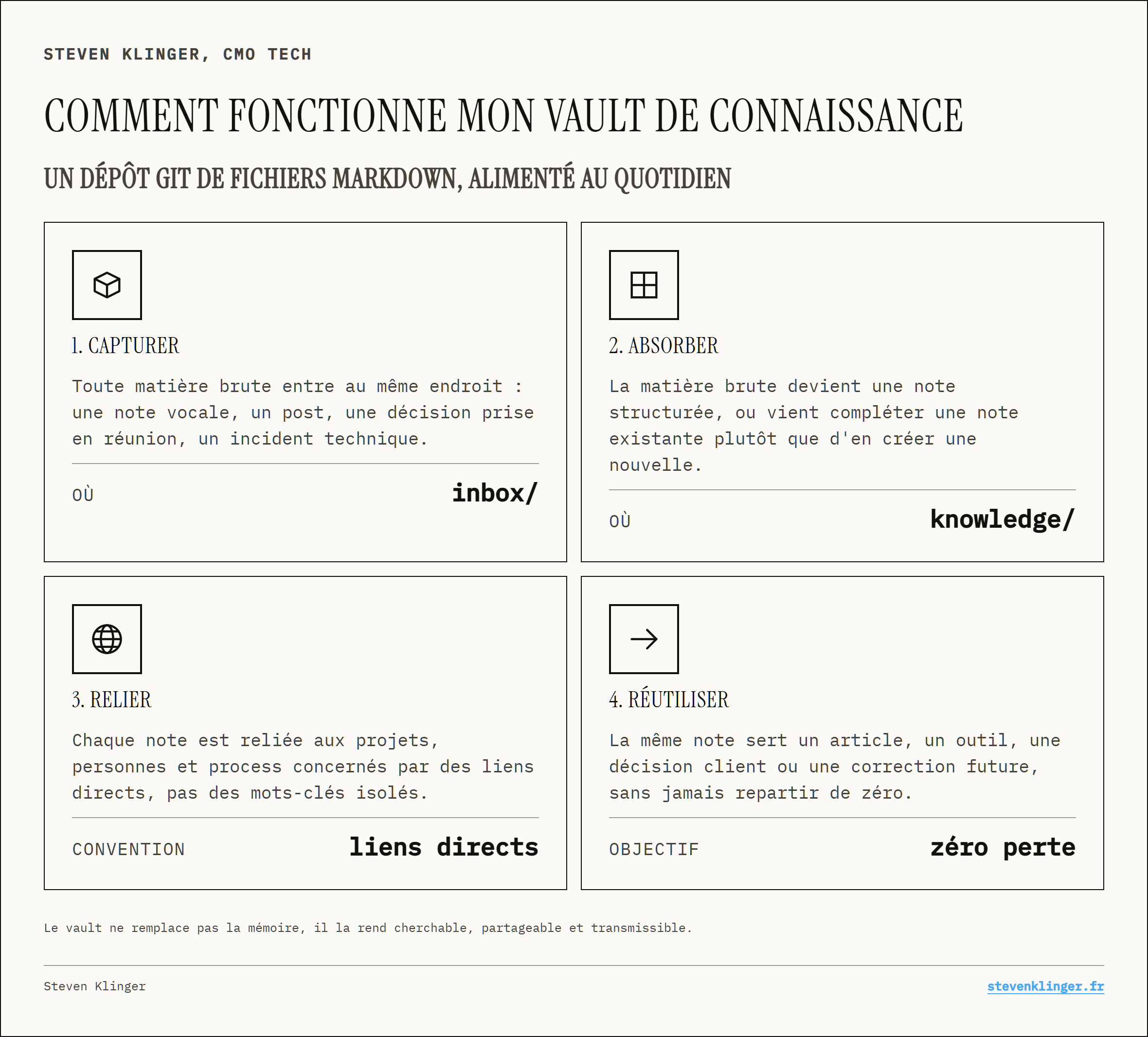
A single entry point for all raw material. A voice note taken between two meetings, a post I’m writing, a meeting transcript, a transcript of a live or a long video, a technical incident spotted on a project: everything goes through the same airlock, before being extracted, understood, sorted and ingested by the system.
**A folder structure that mirrors the real life of a company: ** Projects, people, partner companies, recurring processes, a journal of decisions and corrections over time. Nothing is set in stone: the structure is allowed to evolve, as long as it stays understandable to someone who has never opened the system before. It has to be maintainable and scalable. Otherwise nobody will ever use it.
Living rules, applied in every session. When I correct a method, a way of filing things, or a turn of phrase that doesn’t sound like me, the correction is never applied once and then forgotten. It’s written in a rules note that every future session rereads before working. That’s what keeps me from correcting the same mistake ten times.
Links, everywhere, between notes. A piece of information on its own is useless. A decision linked to the project, to the person, and to the rule it gave birth to becomes usable months later, by anyone, me included (especially when I’ve forgotten the original context).
Agents that work directly inside it. It’s not a filing cabinet you check from time to time. Agents read the vault, look up real information in it before answering, and write in it when new information or a change needs to go in. Several sessions can work in parallel on different topics of the same system without causing problems.
What it’s actually for
The vault absorbs what is usually lost: lives, recorded meetings, sales documents, client feedback, the expertise that lives in the heads of my clients and their teams. It then serves as the base for all the content and sales material I produce, using tools I developed on the side, which work both inside my vault and independently.
An X article extractor. It goes and fetches, directly from the social network, the article I give it, grabs all its formatting and brings it into my vault. Either to republish it on another site (when it’s my own articles), or to build up knowledge on a target topic.
A multi-format infographic maker. It follows the brand guidelines of the projects or companies involved, to lay out precise information quickly. The two visuals in this article come straight from it, by the way.
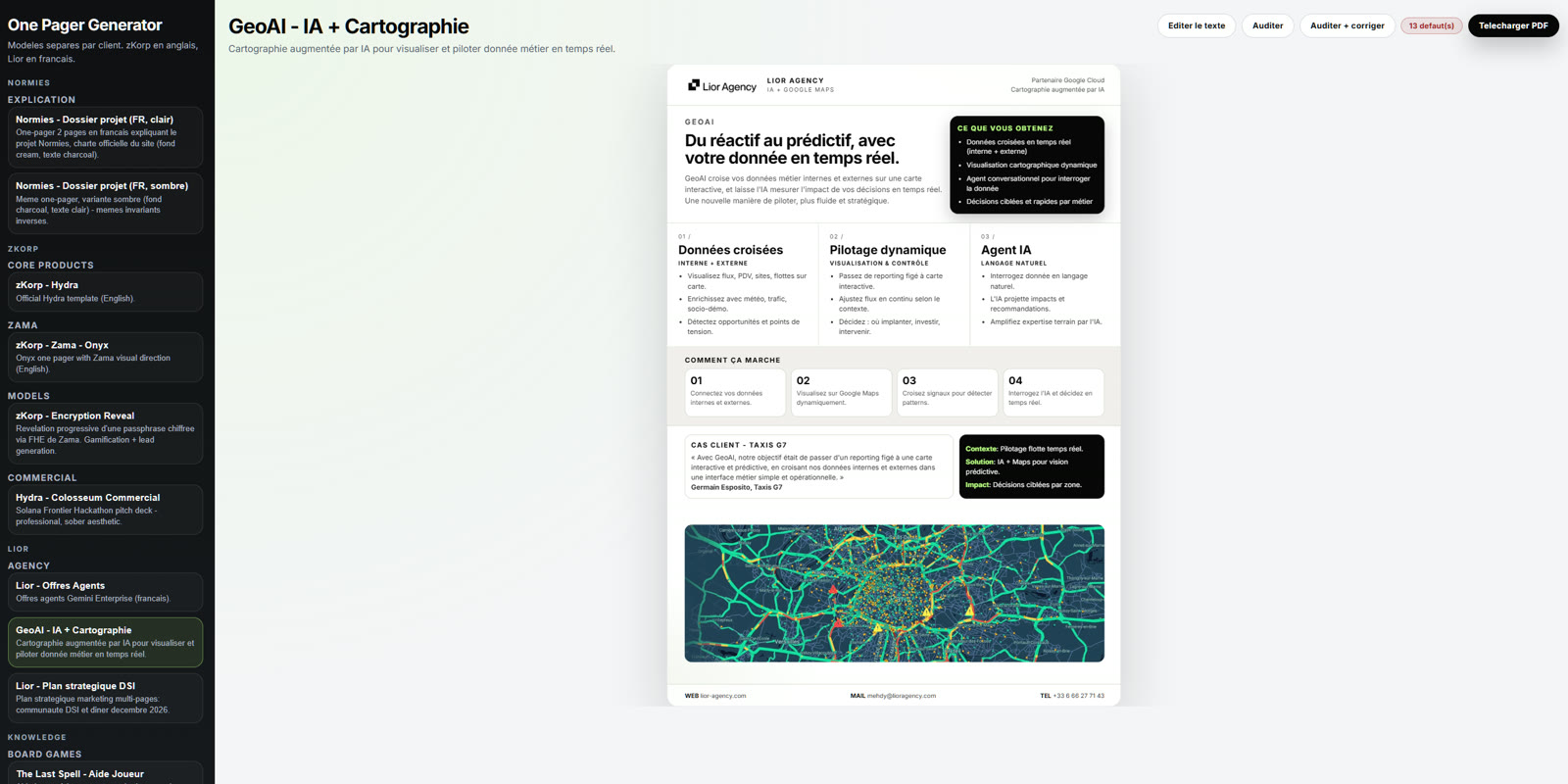
A sales one-pager maker. It creates PDFs that are ready to use, in the brand guidelines of my clients and projects. Driven by AI and editable by hand or by voice if needed.
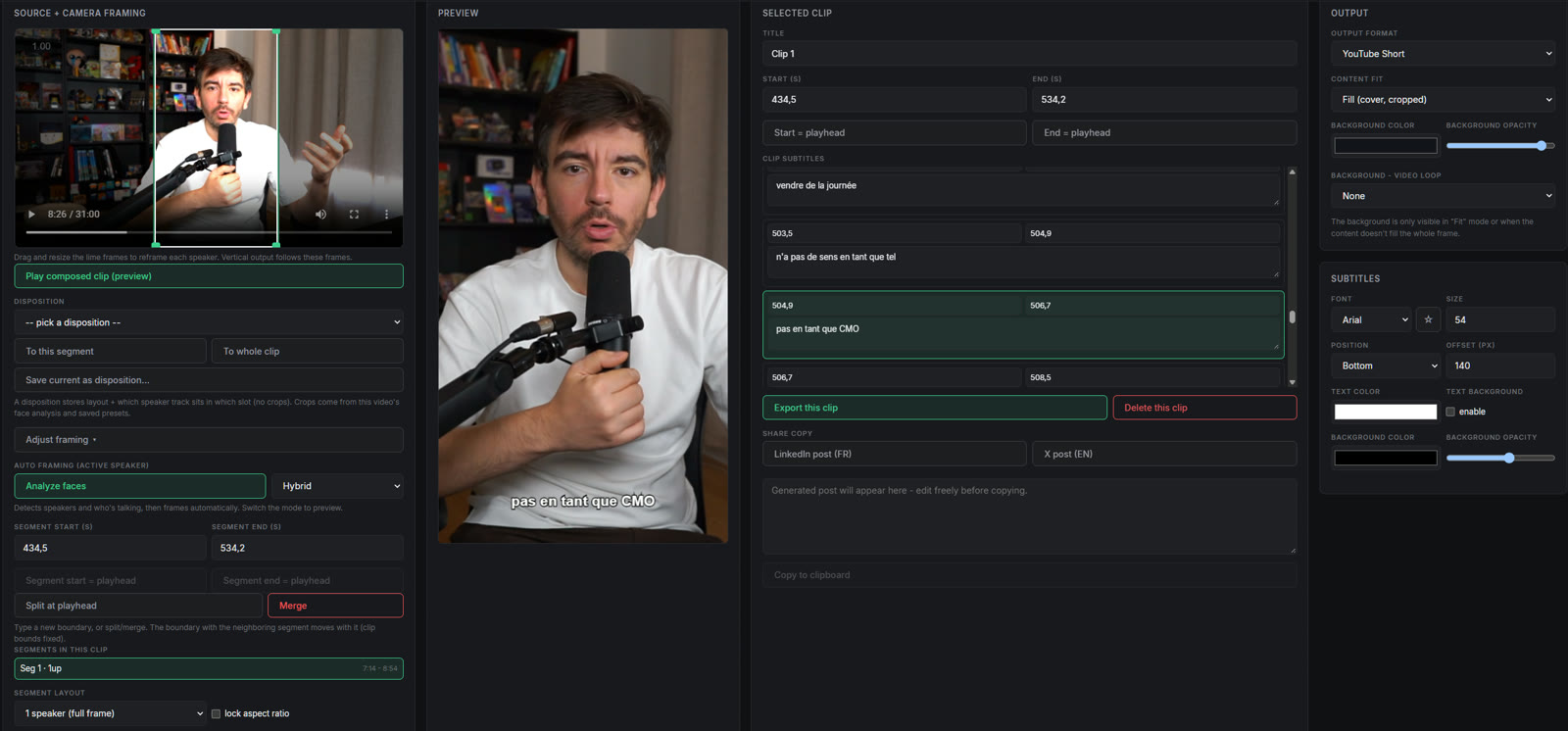
ShortIT, a war machine for managing long-form content. One of my specialties is hosting lives on the Internet. It’s also a very strong marketing communication channel, in both B2C and B2B (even if most of them are, too often, PowerPoint lives...) Except that a live is one to two hours, and then the replay sleeps on an untapped YouTube channel. I built an app that lets me pull the whole transcript of a video and ingest it into the system, which then lets me create other content with that knowledge, update a website and so on. But also create vertical content from these lives, quickly and efficiently. Again, to capitalize on the money and time invested in these long formats!
An NFT and crypto portfolio manager But I’ll tell you about that in detail in another article!

Basically, I never start from scratch. The article I recently wrote about one of my projects was written in a fraction of the usual time, because all the material (the technical decisions, the numbers, the context) already existed, structured and ready to be reused by my system. Of course, there’s a human pass afterwards, but it stays minimal and above all takes less time than before... without losing the quality of the content produced.
That’s exactly the principle: nothing we build should stay locked inside the context where it was created. It’s also the basis of omnichannel in marketing, but that’s a topic for another time.
Every company has its own version of this problem, with its tools, its habits and its resistance to change. If you want us to look together at what it would look like at your place, now is a good time to talk.
In my daily life and in everything I take on
Concretely, every workday starts and ends with the vault.
When a work session gets long, rather than letting it drift and losing everything at the context switch, I write a handover note in my system with a dedicated agent: where I am, what was decided, what’s left to do. The next session picks up exactly where the previous one stopped, even if I’m not the one restarting it. Plus, it saves tokens... everybody wins!
And above all, this system isn’t just consulted, as you’ve understood. It’s corrected continuously. When something sounds wrong, or a method doesn’t work as planned, the correction goes into the system immediately, not just into my head for the next time I think of it (because I’m likely to forget...)
Okay, but how would it work for you?
That’s where I want to take you, because what I do for myself, I also build for my clients, at a different scale.
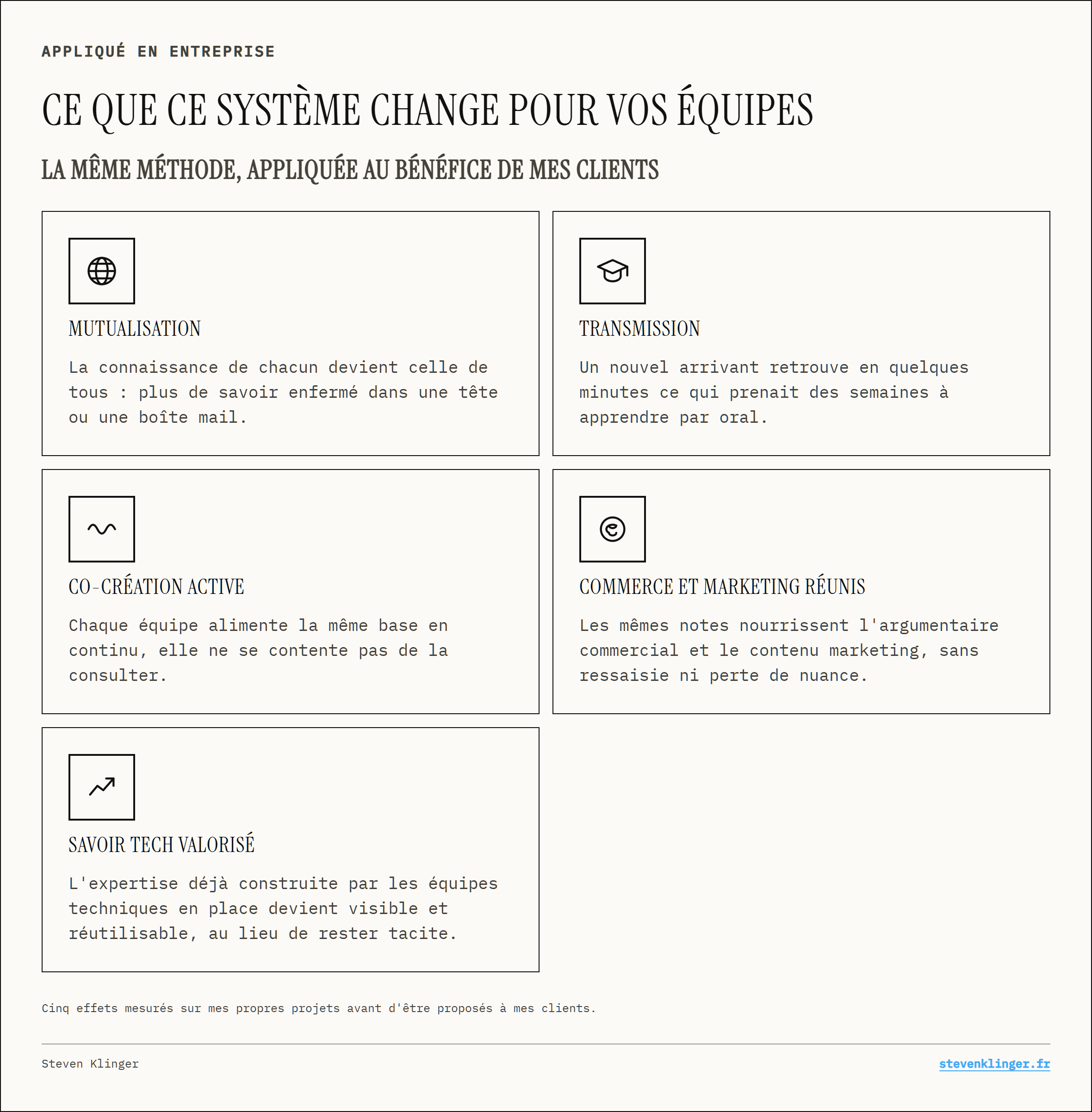
Pool knowledge. What a salesperson learns about a client, what a developer discovers while fixing a bug, what customer support repeats for the tenth time to a user: all of it becomes shared knowledge, instead of staying locked in a private conversation or in a head that will leave one day.
Encourage knowledge transfer. A newcomer on your team shouldn’t spend six months relearning by word of mouth what the company already knows. A well-built knowledge system lets them find in a few minutes what would otherwise be passed on slowly, badly, and incompletely.
Foster active co-creation, not passive consultation. A system that everyone reads but nobody feeds slowly dies, out of sync with reality within a few months. A system that every team feeds continuously, with its own discoveries and corrections, stays alive and reliable, and above all maintainable!
Bring sales and marketing around the same material. These are often two worlds working side by side without ever really working together. The same client knowledge, the same pitch tested in the field, the same concrete proof can feed a sales document and a marketing piece with no re-entry and no loss of meaning or business value between the two.
Get the knowledge of your existing technical teams moving. It’s often the costliest blind spot for you. Your developers and technical experts have already solved most of the problems your company will run into again tomorrow. That knowledge exists, but it stays too scattered, available only to whoever asks the right person the right question at the right time. Making it explicit and searchable changes the speed at which the whole company learns, not just the technical team. It also lets you capitalize even more on your internal and external events, with video capture then integrated directly into the vault for the different actions you need to run, whether sales or marketing.
AI should solve problems by creating specific solutions, not by being a miracle fix for everything.
A knowledge system isn’t one more IT project to hand over to an outside provider who will leave with their method the day the contract ends. It’s a discipline, applied every day, where each person in your company can contribute their stone to the building, and which ends up becoming the invisible infrastructure of everything your company builds next.
That’s exactly what I bring to my clients: I don’t just recommend a tool, I build the system with you, and I make sure it truly belongs to you, not to me. That’s also what marketing is: working to set up coherent internal processes in a company.
If you want to see how I concretely apply this principle and others in my tech CMO missions, I’ve detailed all of it on this page: IA Utile.
In the meantime, thanks for reading, and find me on LinkedIn or by email if you want to talk more about it!
We look together at what a system like this would change for your team, with what you already have in place.