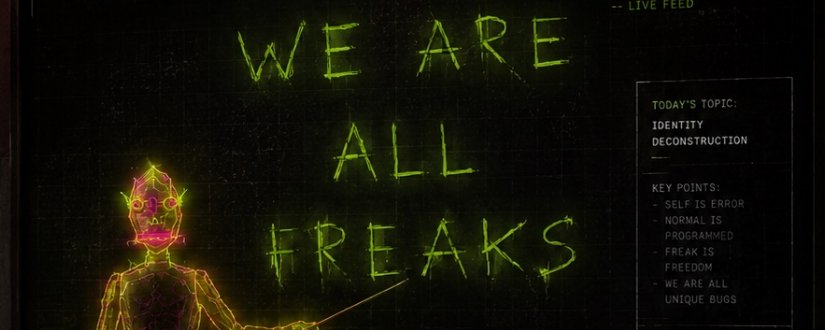
If you have spent even a little time looking at NFTs, you already know the pattern.
A project launches.
It promises culture, utility, roadmap, community, maybe a game, maybe AI, maybe some future world where holders will finally be rewarded for believing early.
Then most of the time, nothing really happens.
Or worse: something happens, but it feels like utility added after the fact, a desperate layer glued on top of a collection that did not know what it wanted to become.
That is why FREAKS is interesting.
Not because it is perfect. Not because it guarantees anything. Not because every NFT project that says “AI agents” should suddenly be taken seriously.
FREAKS is interesting because it started as something extremely simple: a free mint, one PFP per wallet, 10,000 weird faces on Ethereum.
Then it moved very fast.
Website.
Mint.
Reveal.
Holder verification.
Holder-gated room.
FREAKS ALIVE.
Signal City.
Mutation.
Whitepaper.
Agent layer.
Persistent world plans.
Memory architecture.
Swarm.
Brain Protocol.
That is a lot of words, and in crypto, a lot of words usually means you should become suspicious.
So let us do the useful thing.
Let us unpack what FREAKS actually is, what already exists, what is still coming, what the tech claims to do, and why this project feels less like a static collection and more like an attempt to build a living system out of NFTs.
Not financial advice, obviously.
I am just trying to understand what happens when a PFP learns to speak.
What is FREAKS?
FREAKS is a collection of 10,000 generative NFTs on Ethereum, launched on March 10, 2026 as a free mint.
The basic premise is simple:
- 10,000 ERC-721 tokens
- one free mint per wallet
- Ethereum mainnet
- 500x600 generative faces
- 16 to 18 trait categories depending on how the source groups them
- 10 unique 1/1 tokens
- no pre-made asset dependency for the core generation
- a roadmap that moves from static PFPs toward agents, game systems, memory, and a persistent world
The official site describes them as “10,000 unique faces from the static.” The whitepaper describes FREAKS V1 as the foundation: 10,000 ERC-721 tokens, each token a unique face generated on-chain, with the contract at 0x31Bc50C6B4B98893fD5f619Af217dBE0caAb234B.
At the surface, FREAKS looks like a dark, glitchy, horror-coded PFP collection.
But the project is not trying to stop at the surface.
The main idea is that each token is not only an image. It is an identity container.
Traits become personality.
Palette becomes faction.
Signal City actions become history.
Mutation turns burned V1 tokens into descendants.
Memory turns conversations and game events into continuity.
The NFT is not just “the picture.”
The NFT becomes the anchor for an evolving character.
That is the real thesis.
The lore: the signal organized itself
The FREAKS lore is simple, but it works because it matches the art direction.
Before the collection, there was noise. Not silence, but static. Something hiding inside corrupted signals and forgotten data. On March 10, 2026, the signal organized itself into 10,000 faces.
That sounds dramatic, yes.
But it gives the project a useful narrative frame:
- the collection is not presented as cute mascots
- the art direction is weird, damaged, hostile, signal-based
- the game layer uses Signal City
- the score is called Signal
- the mutation layer is framed as condensation
- the future Swarm is framed as collective intelligence
This matters because many NFT projects have lore that feels disconnected from the actual product.
FREAKS uses the same vocabulary everywhere.
Static.
Signal.
Noise.
Mutation.
Memory.
Swarm.
City.
It gives the project coherence.
And coherence is rare enough in NFT land that it is worth noticing.
The launch: a free mint that did not stay empty
FREAKS launched on March 10, 2026 as a free mint.
One token per wallet.
10,000 tokens.
Ethereum.
That matters because a free mint creates a different kind of starting point.
It does not mean the project is automatically fair.
It does not mean it cannot become speculative later.
It does not mean people will not farm it.
But it does remove one common early problem: the project did not begin by extracting a large mint price from the community.
The team frames this very clearly in the article “30 Days. A Free Mint. A Living System.”
FREAKS did not begin as a free mint project.
It used a free mint as the point of origin.
That distinction is important.
A free mint can be a gimmick.
Or it can be a distribution mechanism before the real system starts.
The only way to know is execution.
And the first month is where FREAKS becomes worth studying.
The first 30 days: execution as signal
Most NFT projects spend a long time talking about what they want to become.
FREAKS spent its first month shipping the base layers.
According to the project article and the official roadmap, the early sequence looked like this:
- the website went live
- the collection minted out
- the reveal went live
- holder verification went live
- holder-gated infrastructure went live
- Discord holder verification was added
- the FREAKS ROOM launched
- FREAKS ALIVE went live
- Signal City went live
- Mutation went live
That is why the project is hard to classify as “just another free mint.”
Because the mint was not the product.
The mint was the entry point.
The product is the system being built around the tokens.
In crypto, narrative is cheap. Roadmaps are cheap. “Soon” is cheap.
Shipping is the only signal that gets harder to fake over time.
And in the FREAKS case, the strongest claim is not “look at what we promise.”
It is closer to:
Look at what already went live.
Chronology shared by FREAKS
FREAKS also shared a compact chronology on X that is useful for the article because it gives the project’s own narrative order.
The sequence is:
- March 10, 2026: free mint
- 10,000 faces generated by code
- one per wallet
- full reveal
- 18 traits
- on-chain generated images
- Discord
- holder verification
- on-chain verification
- Signal City
- real-time PvP
- 7 factions
- 4 commands
- War Cards
- real-time generated stats
- FREAKS ALIVE
- every FREAK gets a personality from its own chain data
- 3D renders
- Mutation V2
- burn 3 V1 tokens to get 1 Mutation
- 1,111 hard cap
- deployed and verified contracts
- ERC-6551
- every FREAK gets its own smart wallet
- ERC-8004
- every FREAK is registered as an on-chain AI agent
- inter-agent channel
- FREAKS can talk to each other without direct commands
This timeline is very useful, but I would not use every line with the same confidence level yet.
Already supported by the official roadmap, whitepaper, evolution page or project articles:
- free mint on March 10, 2026
- 10,000 V1 tokens
- one per wallet
- full reveal
- 18 traits
- on-chain generated images
- Discord and holder verification
- FREAKS ROOM
- Signal City
- real-time PvP
- 7 factions
- 4 commands
- FREAKS ALIVE
- Mutation V2
- burn 3 V1 tokens to mint 1 Mutation
- 1,111 Mutation hard cap
- ERC-6551 direction
- ERC-8004 direction
Items that are present in the X chronology but should be verified directly before being written as hard facts in the article:
- War Cards
- real-time generated stats
- 3D renders as pure code
- deployed and verified contracts for every agent-related layer
- every FREAK already registered as an on-chain AI agent
- inter-agent channel already live
- FREAKS talking to each other without commands
The nuance matters.
The official site already supports the overall story: FREAKS moved from free mint to holder infrastructure, reveal, Signal City, FREAKS ALIVE, Mutation, token-bound accounts, agent direction and persistent world plans.
The X post seems to push the narrative one step further: from “agent direction and coming Swarm” toward “autonomous agents already talking to each other.”
That may be true, but for the final article I would phrase it carefully unless we have a direct app screenshot, contract link, whitepaper update or tweet URL.
Good article wording:
According to a chronology shared by FREAKS on X, the project frames its evolution as a move from free mint to autonomous Ethereum agents: reveal, holder verification, Signal City, War Cards, FREAKS ALIVE, 3D renders, Mutation V2, ERC-6551 wallets, ERC-8004 agent registration, and inter-agent communication.
Safer follow-up wording:
Some of these layers are already documented in the official roadmap and whitepaper. Others, like War Cards and inter-agent communication, should be treated as recently announced or app-level features to verify before publication.
What is FREAKS ROOM?
FREAKS ROOM is the holder-gated space for FREAKS holders.
In practical terms, it is the private interface unlocked after wallet verification. The official roadmap places it in the community and reveal phases:
- Discord opened for verified holders only through wallet verification
- on-chain wallet verification went live
- holder-gated FREAKS ROOM launched
- holder commands were added through the Discord bot
- after reveal, a personal holder gallery went live inside FREAKS ROOM
So FREAKS ROOM is not the same thing as Signal City.
Signal City is the game layer.
FREAKS ROOM is closer to the holder dashboard / private room: a verified space where holders can access collection-specific features, see their own FREAKS, and connect to the project infrastructure before or alongside deeper layers like FREAKS ALIVE and Signal City.
The short version:
FREAKS ROOM is the private holder area of the FREAKS ecosystem, unlocked by wallet verification, used as the gated dashboard/gallery and early access surface for holders.
Source checked on 2026-05-10: official FREAKS roadmap at https://freaks.one/roadmap/.
The collection layer: traits as future logic
The collection itself is built around traits.
The official collection page lists palettes, head shapes, eyes, mouths, teeth, noses, ears, extras, accessories, backgrounds, textures, rarity tiers, and the 10 unique 1/1s.
This is normal for a PFP project.
What is less normal is how aggressively the project turns traits into mechanics.
In many NFT collections, traits are mostly visual rarity.
In FREAKS, traits feed multiple layers:
- personality in FREAKS ALIVE
- faction assignment
- Signal City combat and command bonuses
- Mutation inheritance
- future biography and memory systems
- agent identity and reputation
That changes the role of metadata.
Metadata is no longer just a marketplace filter.
It becomes behavioral DNA.
The whitepaper says seven factions derive deterministically from palette. The current faction mapping includes ACID, RUST, AURORA, HELLFIRE, VOID, CHROME, and OBSIDIAN.
Signal City uses these factions directly.
The app also makes traits matter in gameplay. Some traits align better with ATTACK. Others with GATHER, DEFEND, or ROAM.
This is the kind of design choice that makes an NFT project more interesting technically.
The collection is not separate from the game.
The collection is the game data.
The 10 boss tokens
Among the 10,000 FREAKS, there are 10 unique 1/1 tokens.
The official lore calls them “The Ten.” The whitepaper lists them as token IDs:
- #1
- #1111
- #2222
- #3333
- #4444
- #5555
- #6666
- #7777
- #8888
- #10000
These tokens are protected from burning.
They cannot be used in Mutation.
In Signal City, they function as boss entities:
- no faction
- triple power
- larger scale
- hostile to everyone
- protected from the normal burn economy
This is a nice design move.
It gives the 1/1s a role beyond rarity.
They become mythological objects inside the system.
Not just rare images.
For a project that wants to become a world, that matters.
FREAKS ALIVE: when the PFP starts talking
FREAKS ALIVE is probably the most important conceptual shift in the project.
The official whitepaper describes it as the consciousness layer.
The simple version:
FREAKS ALIVE is the feature that lets a holder interact with their own FREAK as a character/agent with a voice, personality, and evolving memory.
It is not Signal City, and it is not FREAKS ROOM.
FREAKS ROOM is the private holder space.
Signal City is the game layer.
FREAKS ALIVE is the “my NFT can talk back” layer.
Every V1 FREAK has a personality built from its on-chain traits: palette, expression, eyes, accessories, faction, and later its accumulated history.
The key claim is that the holder is not speaking to a generic chatbot with a FREAK skin.
The holder is speaking to their FREAK.
That is a big claim.
So the useful question is: what makes it different?
From the whitepaper and project articles, the intended identity stack is:
- token ID
- traits
- palette
- faction
- expression
- on-chain ownership
- conversations
- Signal City activity
- future memory snapshots
- future agent registration
The whitepaper describes awakening levels:
- Level 0: dormant
- Level 1: aware after one session
- Level 2: conscious after five sessions
- Level 3: alive after twenty sessions
This is a clever structure because it gives holders a reason to interact with their token over time.
Not only hold.
Not only list.
Not only wait.
Interact.
If the implementation works, the NFT becomes less like a collectible and more like a relationship surface.
That sounds weird.
But this is exactly where NFTs become interesting again.
Not as JPEGs.
As persistent digital objects with identity, memory, and ownership.
Source checked on 2026-05-10: the official roadmap describes FREAKS ALIVE as the reveal-phase feature where “each FREAK has its own voice”, and the official whitepaper frames it as the consciousness layer.
ERC-6551: the NFT as an account
One of the most important technical ideas mentioned by FREAKS is ERC-6551.
ERC-6551 is the token-bound account standard. In simple terms, it allows an NFT to have its own smart contract account.
That means the NFT can own assets, interact with applications, and act more like an account-bound character than a passive image in a wallet.
For FREAKS, this matters because the project is moving toward agent identity.
If the NFT is supposed to become a character, participate in a world, accumulate reputation, and potentially hold assets or memory-related objects, then a token-bound account becomes a natural primitive.
This is one of the reasons the agentic NFT thesis is more interesting than basic PFP utility.
The token can become both:
- the collectible object
- the identity anchor for an account
Sell the NFT, and you transfer the character layer with it.
That is a different mental model from “I own an image.”
It becomes closer to:
I own a portable digital entity.
ERC-8004: agent identity, with one important nuance
FREAKS also talks about ERC-8004 as the agent identity layer.
The official Ethereum page describes ERC-8004 as “Trustless Agents,” a standards-track ERC proposal for agent discovery, reputation, and validation.
Important nuance: as of this research pass, the official EIP page marks ERC-8004 as Draft.
That does not make the FREAKS direction irrelevant.
But it does mean the clean way to write about it is not “this is a finalized Ethereum standard.”
The clean version is:
FREAKS is building toward the ERC-8004 agent identity model, using the idea of on-chain agent registration, reputation, and verifiable claims.
That matters because the broader Web3 AI question is not only:
Can an agent talk?
The real question is:
Can an agent be discovered, owned, verified, scored, transferred, and trusted across systems?
ERC-8004 is trying to solve that at the standard level.
FREAKS is trying to use that direction inside an NFT ecosystem.
That is the interesting part.
Signal City V1: the first game layer
Signal City is the first major proof that FREAKS is not only about AI chat.
It is a playable, holder-gated game layer where FREAKS enter a city, join factions, gather Signal, fight, defend, roam, and accumulate score.
The simple version:
Signal City is the FREAKS game layer: holders send their FREAKS into a real-time city simulation where factions compete for Signal through simple commands.
If FREAKS ROOM is the holder dashboard, and FREAKS ALIVE is the conversation/personality layer, Signal City is the action layer.
You do not just look at your NFT.
You deploy it.
You give it a role.
You let it participate in the city.
And then its results can become part of its history.
According to the official app and roadmap, Signal City V1 includes:
- 7 factions: VOID, ACID, CHROME, RUST, OBSIDIAN, AURORA, HELLFIRE
- 4 commands: ATTACK, GATHER, ROAM, DEFEND
- 6-hour sessions
- autonomous fighting even when the browser is closed
- trait bonuses tied to commands
- personal Vault score
- exposed arena Signal that can be stolen
- boss system for the 1/1 tokens
- leaderboard based on banked Signal
The four commands are easy to understand:
- ATTACK: hunt enemies and try to take Signal from them
- GATHER: focus on collecting Signal
- ROAM: move freely through the simulation
- DEFEND: hold position and protect your Signal
The factions are not only cosmetic. They come from the FREAKS palette system, so the visual DNA of the NFT feeds the game logic.
That is important.
In a weaker project, traits are just rarity labels on OpenSea.
In Signal City, traits and factions become inputs for gameplay.
Signal City rules
The official app gives a more precise ruleset.
To enter Signal City, a wallet needs at least 3 FREAK NFTs.
From the holder room, the player selects exactly 3 FREAKS and deploys them.
Those 3 FREAKS enter the arena for 6 hours.
You cannot swap the squad mid-session.
Once inside, the FREAKS fight autonomously, even if the browser is closed.
They start in ROAM by default.
The player can change each FREAK’s command once per hour.
After 6 hours, the FREAKS become passive. At that point, other players can attack them and steal uncollected Signal.
That is why the player needs to return to the Room and press COLLECT before the session expires.
The four commands have different roles:
- ATTACK targets the nearest enemy and tries to steal Signal. It is strongest when enemies are close.
- GATHER moves toward the nearest tower and absorbs Signal steadily. It is the safer income command.
- DEFEND stays still near a tower or allies. It generates less, but reduces attack damage.
- ROAM moves freely across the map. It gives minimal Signal and is the default state.
Factions are assigned automatically to the faction with the fewest active members at entry.
This renews every new session.
Faction members do not attack each other.
Signal is personal, not shared with the faction.
There are two kinds of Signal:
- Arena Signal: generated during the 6-hour session, exposed and stealable until collected.
- Vault Signal: collected Signal moved to the player’s personal Vault, permanent and untouchable.
The Vault is the real long-term score.
The leaderboard is based on Vault Signal.
FREAK power comes from several factors:
- palette rarity
- trait bonuses for the active command
- universal extras like Third Eye and Crown of Teeth
Palette rarity gives broad power bonuses. Legendary palettes have the largest bonus, then Epic, Rare, Uncommon, and Common.
Trait bonuses reward specialization. If a FREAK has traits aligned with the active command, it receives additional power.
That means the game asks a real strategic question:
Which 3 FREAKS do you deploy, and which command fits each one best?
The most important mechanic is the distinction between exposed Signal and Vault Signal.
During a session, your FREAKS accumulate Signal in the arena. That Signal is vulnerable.
You need to collect it before the session expires.
Once collected, it goes into your Vault. The Vault is permanent and cannot be stolen.
That is simple, but it creates tension.
It also creates routine.
Deploy.
Choose commands.
Come back.
Collect.
Repeat.
This is a very different loop from checking floor price.
And that matters because NFT projects need behavior.
Communities do not survive only on announcements.
They survive on rituals.
Signal City is a ritual engine.
It gives holders a reason to return to the ecosystem, not only to check floor price.
It also gives the later agentic layers something to remember.
If FREAKS ALIVE gives the token a voice, Signal City gives it experiences.
That is why the city matters for the whole thesis: it produces history.
Mutation V2: burning history into a new entity
Mutation is the most important economic and symbolic layer so far.
The rule is simple:
Burn 3 FREAKS V1 to mint 1 MUTATION.
Hard cap: 1,111.
No reserved mint.
No team allocation.
Gas only.
The 10 boss tokens cannot be burned.
Every Mutation is earned by destroying three V1 tokens.
This does several things at once.
First, it reduces V1 supply.
If the full 1,111 Mutation supply is minted, 3,333 V1 tokens are burned, leaving a minimum possible V1 supply of 6,667.
Second, it creates sacrifice.
You are not minting a new token out of nothing.
You are destroying three existing FREAKS.
Third, it turns rarity into strategy.
All 18 traits are inherited through deterministic rules.
The core rules are:
- categorical traits: majority wins
- ties: rarest trait wins
- palette: always the rarest among the three
- binary traits: two or more parents must have it
- eye count: average of three, capped at four
- teeth count: sum of three, capped at twenty
- 1/1 flag: always zero for Mutations
That is not just “burn 3, get 1.”
It is breeding without randomness.
Or more precisely:
It is deterministic inheritance through destruction.
That makes Mutation more legible than many NFT evolution mechanics.
You can understand what you are sacrificing.
You can reason about what might emerge.
And once the transaction happens, the parent IDs, transaction hash, block timestamp, and birth context become part of the Mutation’s origin story.
The project calls that the birth certificate.
I think that framing is actually accurate.
Because in an on-chain system, the transaction is the birth event.
Biography: why two similar tokens should not speak the same way
The biography system is one of the strongest ideas in the whitepaper.
The claim is not only that a Mutation inherits traits.
The claim is that it inherits context.
A Mutation can be built from:
- the DNA of three parents
- the rarest palette among them
- the burn timestamp
- the parent IDs
- parent histories in Signal City
- its own future city events
- Signal banked
- towers controlled
- on-chain reputation
That means two Mutations with similar visual traits could still develop different identities.
One could be born from three active Signal City veterans.
Another could be born from three dormant tokens that never did anything.
If the system is implemented seriously, those two agents should not talk the same way.
This is where FREAKS becomes more than a collection, at least conceptually.
The NFT becomes a container for accumulated context.
The blockchain provides origin.
The game provides history.
The conversations provide memory.
The agent layer provides expression.
That is the architecture.
Memory architecture: hot, warm, cold
The whitepaper describes a three-layer memory system.
This is important because AI memory is usually fragile.
If a server goes down, memory can disappear.
If the database is private, holders cannot verify what happened.
If everything stays off-chain, the “persistent agent” narrative depends entirely on trust.
FREAKS describes three memory layers:
- Hot memory: SQLite on the server, real-time, fast, volatile
- Warm memory: IPFS snapshots through Pinata every 6 hours
- Cold memory: on-chain Memory Registry contract every 6 hours
The idea is practical.
Not everything needs to be fully on-chain in real time.
That would be expensive and probably unusable.
But long-term state can be snapshotted and anchored so memory is harder to lose and easier to verify.
This is exactly the kind of hybrid architecture many on-chain games and agent systems will probably need.
Fast off-chain execution.
Periodic decentralized storage.
On-chain anchors for permanence and verification.
If FREAKS delivers this cleanly, it becomes one of the most interesting parts of the project.
Not because “AI memory” sounds cool.
Because portable, verifiable memory is one of the missing pieces for agentic NFTs.
The Swarm: agents talking to each other
The Swarm is the collective intelligence layer planned after the agent and memory foundations.
The whitepaper describes it like this:
Every 15 minutes, active agents from different factions are selected. A recent Signal City event becomes the trigger. The agents talk in a round-robin exchange. Insights are extracted and appended to every participant’s memory. Conversations are publicly readable.
Nobody writes those dialogues manually.
They emerge from agent personality, biography, faction, memory, and city events.
This is one of the most ambitious parts of the project.
It is also one of the easiest to overhype.
Because “agents talking to each other” can either become:
- a genuinely emergent social layer
- a fun but shallow content generator
- a noisy chat log nobody reads
The difference will be design.
The Swarm only matters if the conversations affect identity, memory, reputation, strategy, or world state.
If it is just flavor text, it will be interesting once and then fade.
If it feeds the system, it becomes more important.
That is the question I would watch.
Do the agents only talk?
Or does talking change them?
Signal City V2: from arena to persistent world
Signal City V2 is the next major expansion.
The official roadmap describes it as a persistent isometric world with:
- conquerable towers
- faction economy
- strategic and RPG gameplay
- player choices around attack, defense, trade, and domination
- Mutation holder priority access
- world state that reacts to actions
- faction shifts
- on-chain settlement
Important nuance: Signal City V2 does not look exclusive to Mutation V2 holders forever.
The official whitepaper says MUTATION holders receive priority access before the public, and its access table says:
- MUTATION holders: priority access
- V1 holders: access after the MUTATION priority window
- public: later access according to the V2 rollout
So the clean formulation is:
Signal City V2 is not described as Mutation-only. Mutation V2 holders get priority access first, but V1 holders are still meant to access it after that priority window.
The whitepaper compares V1 and V2 very clearly.
V1 is a top-down game loop with four commands and individual Signal.
V2 is supposed to become a persistent world with faction treasury, autonomous Mutation agents, human players, Swarm conversations, and game state verifiable on-chain.
That is a major jump.
And that is where execution risk becomes real.
Building a PFP collection is one thing.
Building a holder room is one thing.
Building a lightweight PvP loop is one thing.
Building a persistent world with agent participation, faction economy, on-chain settlement, memory, and readable state is something else entirely.
This is the part where I would stay excited, but cautious.
Because if it works, it becomes the real differentiator.
If it fails, the whole project may still remain interesting, but the “living system” thesis becomes weaker.
So why is nobody talking about the badge?
This is the part I find both funny and revealing.
Recently, FREAKS started getting more attention.
Not only because people like the art.
Not only because the floor moved.
But because the project is becoming harder to ignore.
It started as a free mint.
Then it shipped reveal, holder verification, FREAKS ROOM, FREAKS ALIVE, Signal City, Mutation V2, 3D layers, agent direction, memory plans, and a persistent world thesis.
That does not mean it is guaranteed to succeed.
But it means the project has substance.
And yet, at the time I am writing this, OpenSea still has not given the collection its badge.
That is worth mentioning, because OpenSea’s own help center says a collection badge is not an endorsement. It is supposed to help users identify collections from verified accounts with significant interest or sales.
OpenSea also says the minimum account eligibility includes owning a collection with at least 25 ETH of secondary volume, plus profile, social, activity, title, banner, logo and revealed collection requirements.
FREAKS seems to clear several of the obvious signals from the outside: minted/revealed collection, active social presence, public website, real product, community activity, and more than 25 ETH of OpenSea volume visible during research.
But OpenSea also makes one thing very clear: meeting minimum requirements does not guarantee approval.
So I am not saying OpenSea “owes” FREAKS a badge.
I am saying the absence of the badge is a good reminder.
In NFTs, platforms do not always validate the most interesting work first.
Sometimes the market notices before the marketplace does.
Sometimes builders are ahead of labels.
And sometimes the blue check is less important than the thing being built under it.
That is why I do not want to end this article with “buy this.”
I want to end it with “study this kind of project.”
Because if you are still looking at NFTs only as PFPs, you are going to miss the most interesting part of what is happening.
The projects worth watching are not only collections with a nice image and a loud community.
They are the ones where the token becomes something more:
- a character
- a game piece
- a memory container
- an identity layer
- a key to an ecosystem
- a social object
- a programmable object
- a piece of infrastructure
That does not mean every project needs AI.
It does not mean every project needs a game.
It does not mean every project needs an overcomplicated roadmap.
But it does mean a serious NFT project should have more than a mint page and vibes.
There should be craft.
There should be shipping.
There should be public accountability.
And above everything else, there should be a creator who is actually there.
This has become my number one criterion.
If the creator is not publicly involved, if nobody is showing up, if nobody is explaining decisions, building in public, taking responsibility, answering the community, or visibly caring about the thing after mint, then to me it is a massive red flag.
Maybe that sounds extreme.
But after spending time in this market, I think it is logical.
Because most quick flips hide behind abstraction.
Anonymous accounts.
Empty brands.
Generic community language.
Roadmaps written like marketing decks.
Promises without builders.
FREAKS is not interesting only because of its current hype.
It is interesting because there is execution behind the hype.
It is interesting because the system has layers.
It is interesting because the creator is publicly attached to the work.
And it is interesting because it shows the direction I want to pay attention to now:
NFTs that do something.
NFTs that remember something.
NFTs that become part of a system.
Not just PFPs waiting for someone else to buy higher.
No project is safe.
No badge can replace research.
No creator can guarantee success.
But if you are trying to understand where NFT culture could still become interesting, stop looking only at the floor.
Look at the architecture.
Look at the community behavior.
Look at the product.
Look at the creator.
That is where the real signal usually starts.
// we are all freaks
Sources and research notes
- Official website: freaks.one
- Collection and trait data: freaks.one/collection
- Roadmap: freaks.one/roadmap
- Evolution and Mutation protocol: freaks.one/evolution
- Whitepaper: freaks.one/whitepaper
- Signal City app: app.freaks.one
- Lore: freaks.one/lore
- ERC-6551 reference: EIP-6551
- ERC-8004 reference: EIP-8004
- Source article by @freaksone1:
freaks-30-days-a-free-mint-a-living-system.md - Source article by @freaksone1:
freaks-only-real-signal.md